If your mornings feel chaotic, I get it. I have lived it.
My household is a neurodivergent household, which means my children and I process information and manage time differently. When my oldest started school, the morning routine struggle really surfaced. Getting everyone fed and out the door on time felt impossible, and at that point I only had one child in school. I tried everything. I found tools and tricks that helped, but nothing ever became second nature. The routine still felt effortful and overwhelming.
Eventually I dove into executive function. As a speech-language pathologist, cognition is part of my scope of practice, and I started learning how closely language, memory, and behavior are connected. That was the missing link. It wasn't a quick fix, but once I understood what I actually needed to address, I could finally give myself and my kids the support we needed.
The visual schedule, with a twist
I've tried visual schedules many times: printables, checklists with sliding buttons, dry erase boards, you name it. What I kept seeing was this: my child would finish a task, stand there confused for a second, then walk back to the list for the next step. That sounds harmless, but in a neurodivergent household, that gap between one action and the next can derail the morning for 5 to 10 minutes.
Why visual schedules alone don't stick
Moving from one step to the next means holding the next step in mind, and that depends on working memory and the inner language we use to guide ourselves. For information to get into long-term memory, it has to be encoded, and one of the most reliable ways to encode something is to rehearse it. When my kids and I say the steps out loud, we're giving the brain repeated practice with the sequence, which can help build the inner voice that eventually runs the routine on its own. A list can show the steps, but it can't do that practice for them.
The fix: say the routine out loud
I stopped worrying about which type of checklist to use. I still use a visual checklist, but now my goal is to recite the routine as many times as possible. The more repetitions my kids get, the better the steps encode. We say it together: "I brush my teeth, wash my face, make my bed..."
We typically recite first thing in the morning. While my kids look over their schedule, I have them say the steps out loud. Over time I fade the support: instead of reciting with them, I hold up a finger for each step to prompt them to say it from memory.
Two things make it work for us:
- Keep it to 4 or 5 steps. That's the sweet spot for my kids.
- Keep the steps in the same order every day.
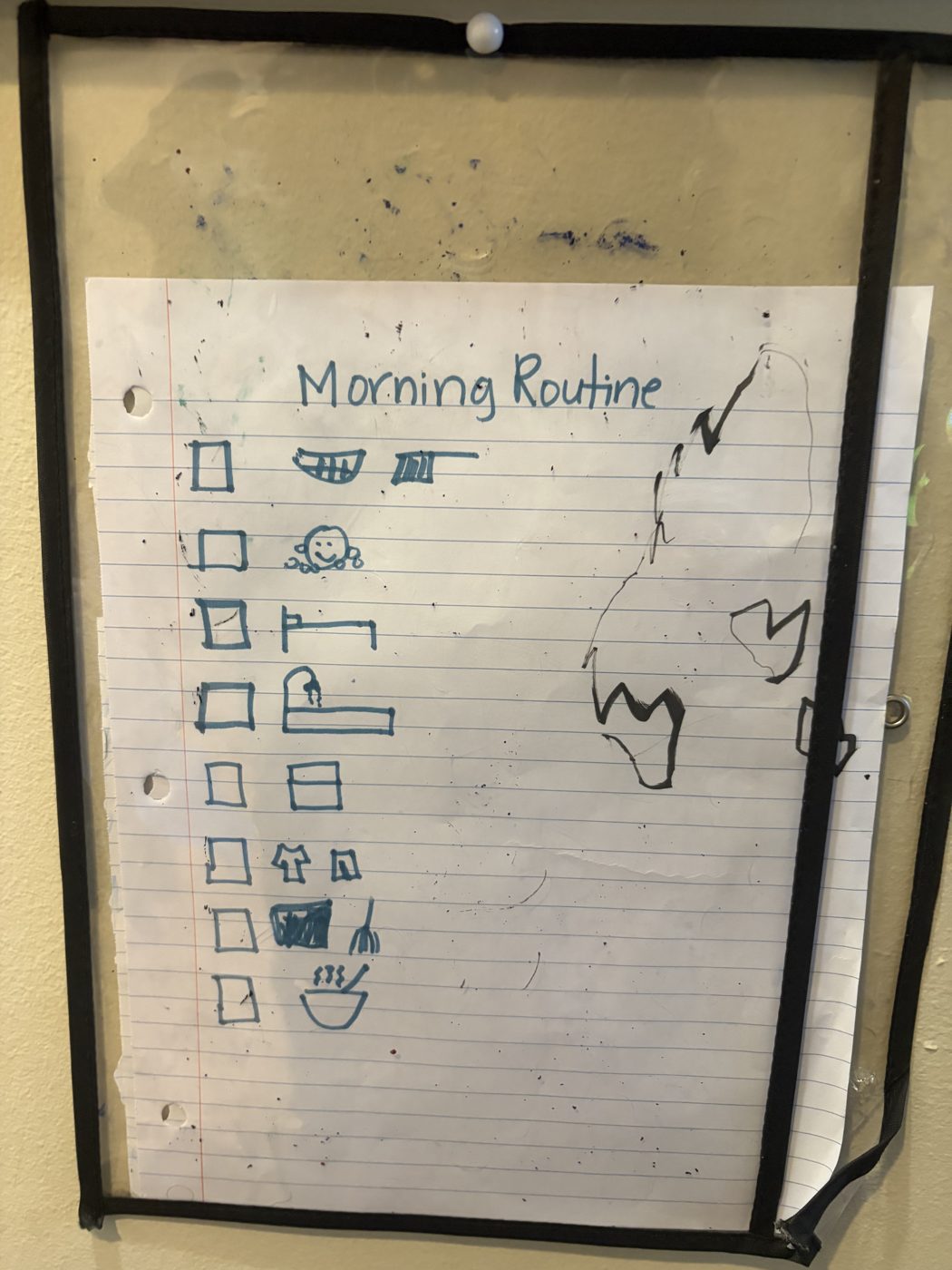
Try this tonight
Grab a pen and paper, draw four steps, and say them out loud together. Repeat tomorrow morning. This can work for adults too! Once the routine starts to stick, you may start to see your child moving through their steps without prompting and without looking at their schedule.
This is what has worked in my family. It isn't individualized advice for your child.